Sonam Dolma
Seeking Oneness
During her residency, Sonam Dolma created Oneness, a collaborative installation with the Charleston community, alongside a series of abstract paintings shaped by memory, devotion, and reflections on place and exile.
Sonam Dolma
Seeking Oneness
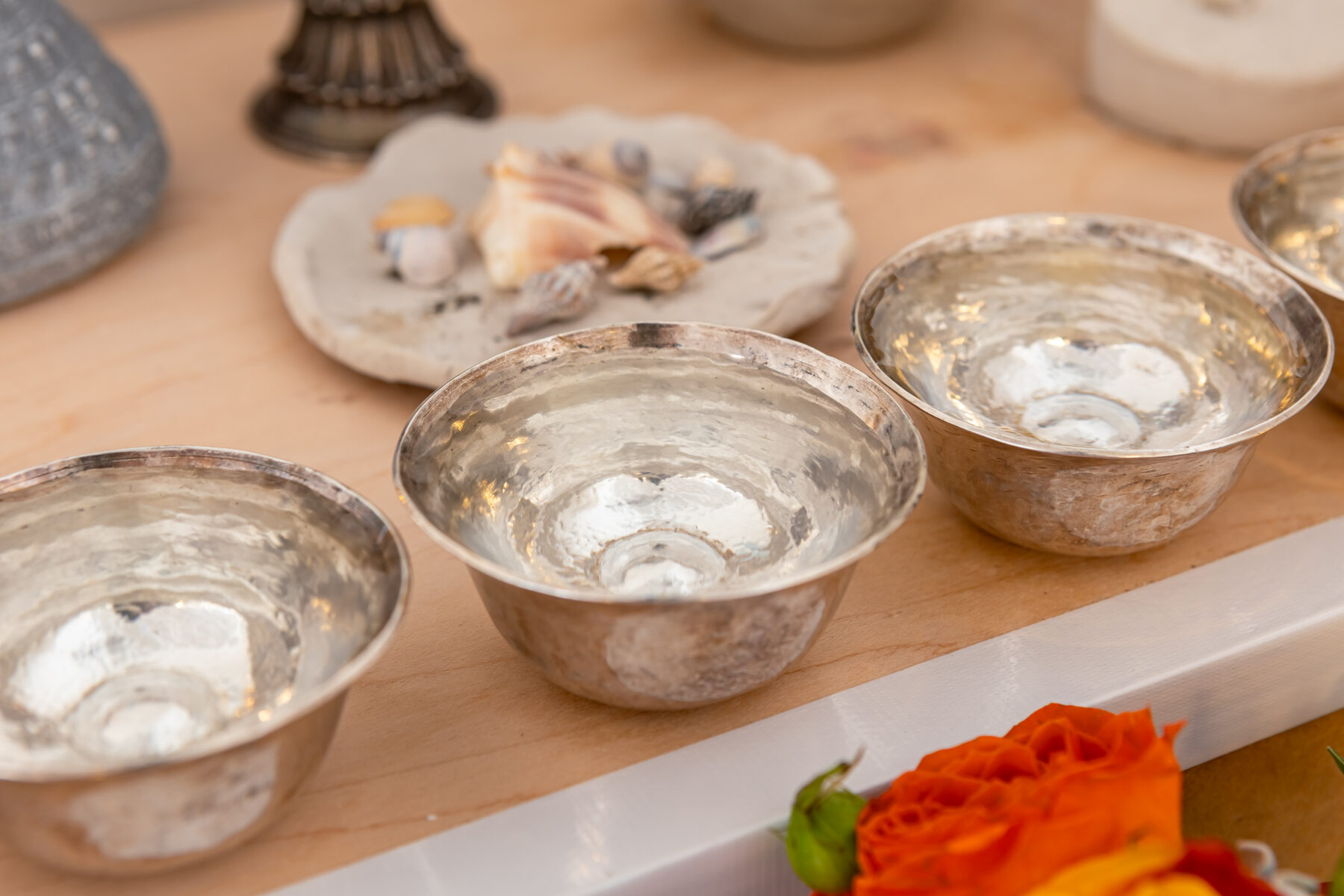
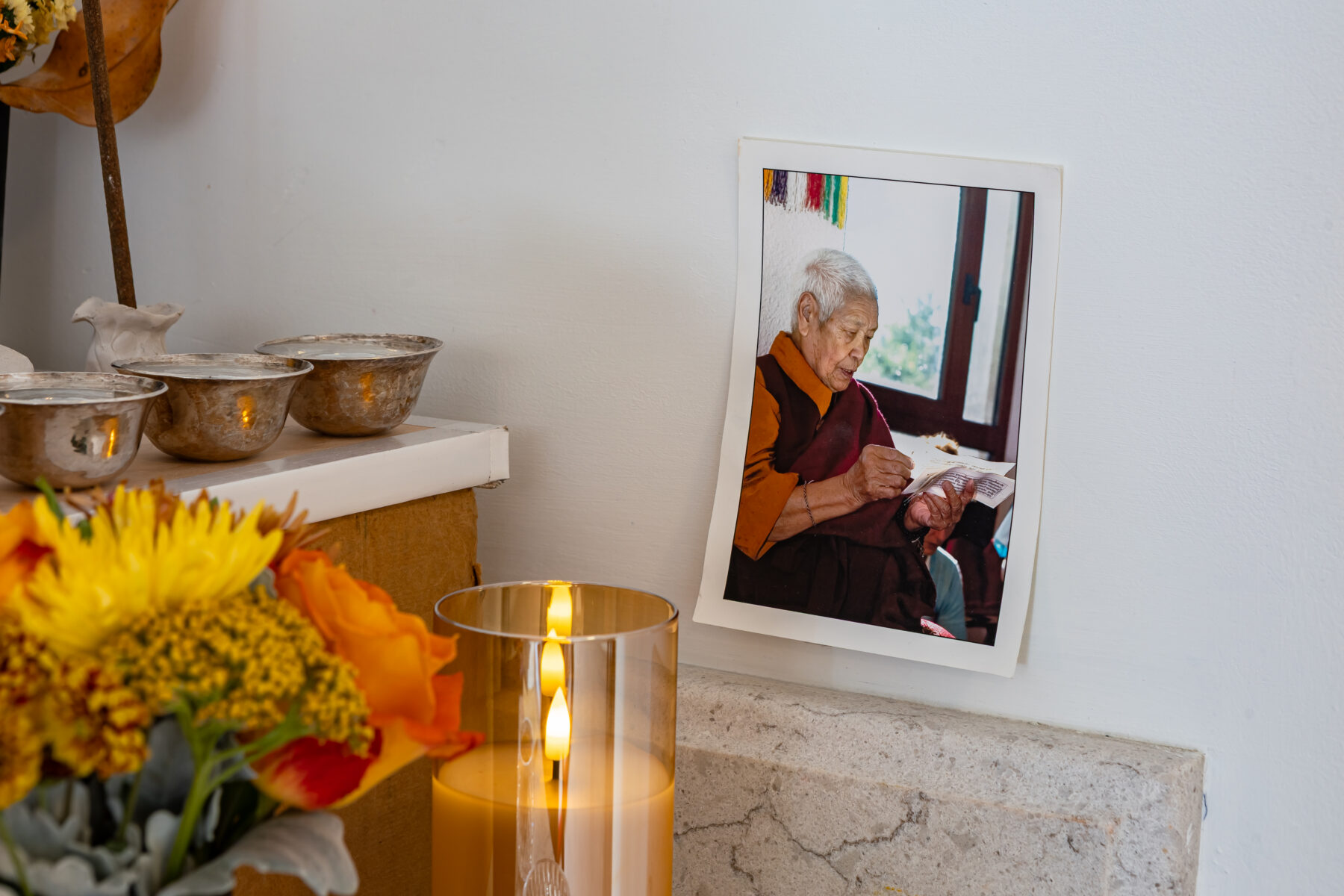
Prior to her arrival in Charleston, Sonam Dolma had conceived a project that she called Oneness, a continuation of the collaborative performances and installations that she first began in 2023. After settling into FSA’s carriage house, she hung Tibetan prayer flags in the garden and set up a shrine in the corner of her studio. Notably, it held flowers, candles, tsa tsas (Tibetan votive objects), silver water vessels, barley seeds, mustard grains, and photographs of the Dalai Lama and her late mother. On this altar she also placed things that she had collected, or that were given to her, in Charleston. These actions and objects prefigured the shape of her ensuing residency in important ways. The works Dolma produced in Charleston—several paintings in addition to Oneness—extended her own heritage, ritual, biography, and memory, through many acts of sharing, into the local community.
Since 2008, Dolma has been increasingly working with installations and these form the core of her practice today. A particularly notable series employs Tibetan votive objects known as tsa tsas, which the artist creates using a treasured brass mold with which her family escaped Tibet. Dolma had this mold replicated in order to expand her artmaking into a collaborative gesture. Over the six weeks of her residency, she held numerous workshops—in churches, college classrooms, her studio—relating their form and making to her own life story and to universal concepts such as death, remembrance, peace—that many participants embraced.
Traditionally, tsa tsas are associated with Buddhist merit-making and mortuary practices; Dolma’s workshop participants were, accordingly, encouraged to place written prayers, mementos, and other items of personal significance into their tsa tsas. Dolma provided them with mustard seeds, which she associated with a Tibetan story related by her late mother about death and grief. She also shared her barley seeds which had been blessed by the Dalai Lama. For Dolma, barley seeds are especially poignant reminders of her family’s flight from Tibet during which their only sustenance came from barley flour mixed with water. For the FSA Garden Party + Open Studios, Dolma arranged all the tsa tsas that she and the community had made into a preview of the installation Oneness that would conclude her collaborative performance the following day.
Although themes and objects referencing Buddhism and Tibet appear frequently in Dolma’s work, she does not employ traditional visualities. Many of her artworks tend toward abstraction; this is true of her installations and is especially evident in her paintings where colors and vaguely identifiable forms reflect her past and present subjectivities. Dolma began her career as a painter and she regularly returns to painting as a way of sustaining her self-expression. During her residency, she produced several canvases that fully incorporated her Charleston experiences into her painterly vocabulary. Moody colors, architectural references, and plant detritus formed images recalling her loved ones, a distant homeland, lost traditions, and Buddhist and other spiritualities. Dolma’s paintings and installation were expansive in their capacity to address many narratives of life’s journey.
John Clang
Selected Works from Reading by an Artist
John Clang’s Reading by an Artist exhibition at The Gibbes Museum of Art (March 25 – April 10) was the first instance in which the artist’s performance was accompanied by the full complement of its corollary visual and interactive installations. The personal readings at the heart of the exhibition were held through Zoom appointments at the museum. These readings were based on Clang’s mastery of zi wei dou shu (Numbers of the Northern Dipper in the Palace of Purple Sublimity), a tenth-century imperial Chinese metaphysical art that traces its roots to the ninth century BCE Yi Jing (Book of Changes). Clang’s practice seeks to create metaphysical portraits—likenesses that come into sharper focus as his interactions with a sitter provide clarity regarding destiny and the choices by which it is shaped.
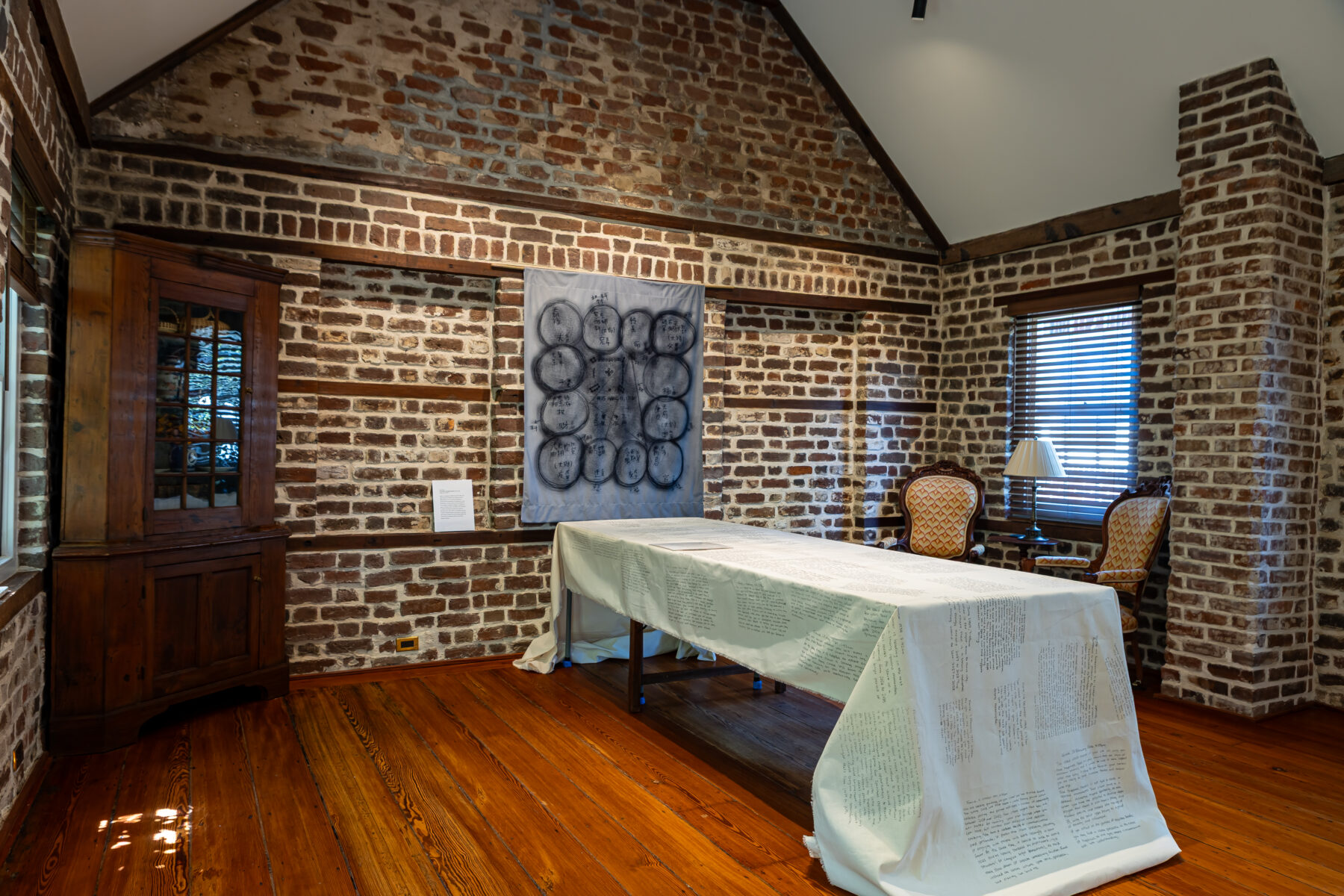
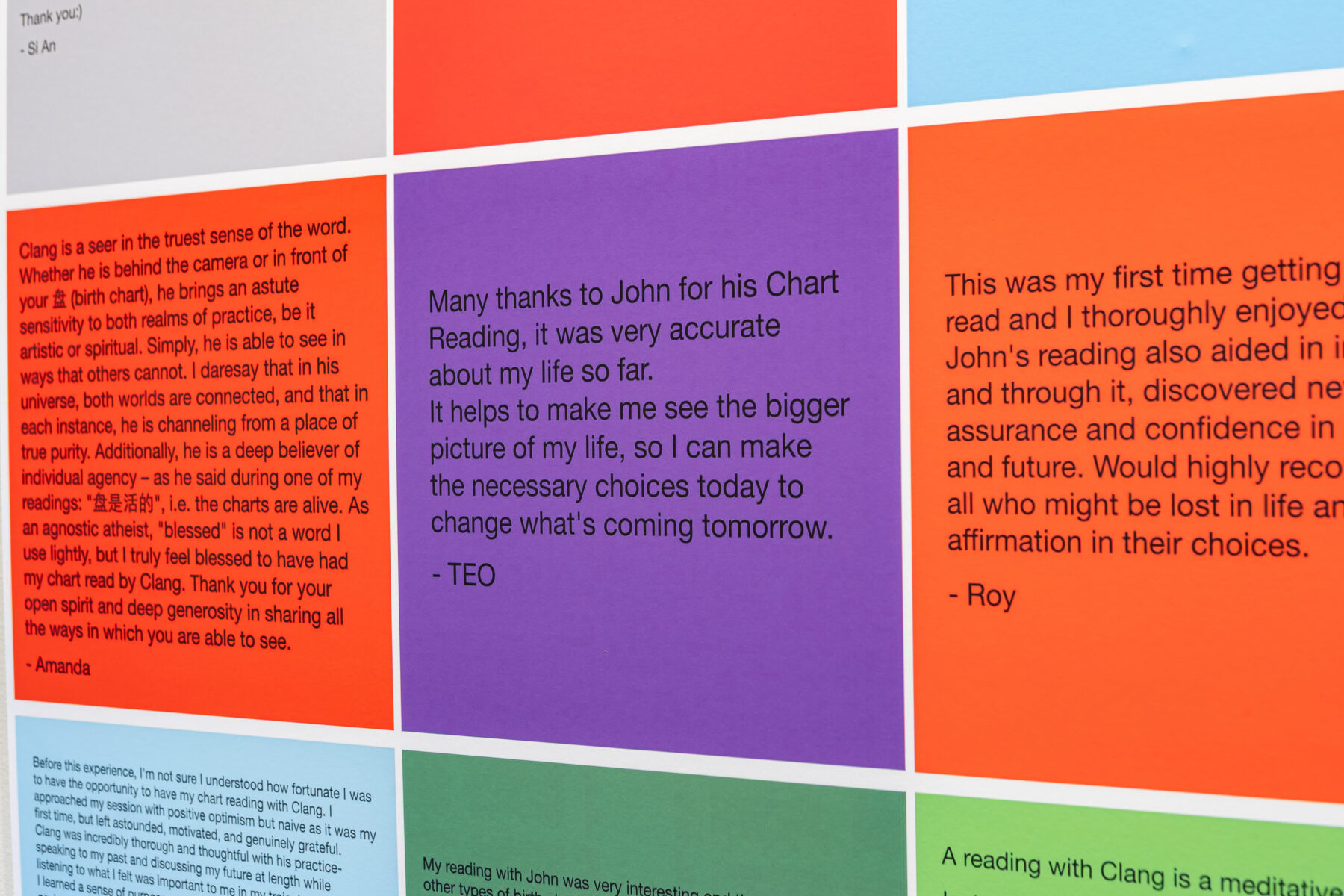
Reading by an Artist has expanded, since its first iteration in 2023, to include several installations. Clang considers these to be expansions of his reading performance, amplifying the experience into an unfolding collective encounter. Following the end of his exhibition at the Gibbes, FSA temporarily installed three of the artworks in the kitchen house studio. These works included the destiny chart (ming pan) that he had created for the Gibbes Museum, The Testimonial Series, and the final canvas from Table of Inquiry.
The Testimonial Series records various responses to John’s readings that subvert traditional art critiques. The texts, some of which are very personal and express deep gratitude, also reveal the importance of interpersonal connections and experiences. Human social consciousness also informs Table of Inquiry which contains answers to specific questions that viewers typically send to Clang via a QR code. At the Gibbes, Clang communicated his answers to museum staff who inscribed them in pencil on a large canvas cloth. The final canvas, covered with handwritten text became a material record of shared concerns, a site for recognizing oneself in an unknown other and recalling a shared humanity.
Reading by an Artist, and its extensions, have grown out of Clang’s photography work which is concerned with the nature of modern-day human interaction across disparate spaces and time zones. Clang continued these explorations at the Gibbes, casting it as a “third space” where deeply interpersonal encounters between the artist, visitors, and others unfolded.
To watch Clang’s public talk at the Gibbes Museum of Art, moderated by the museum’s President and CEO, Alex Rich, and FSA’s curator, Tushara Bindu Gude, click on the yellow video box below.
To read more about the works in the exhibition, click on the links at the bottom of the page.