Artist-in-Residence
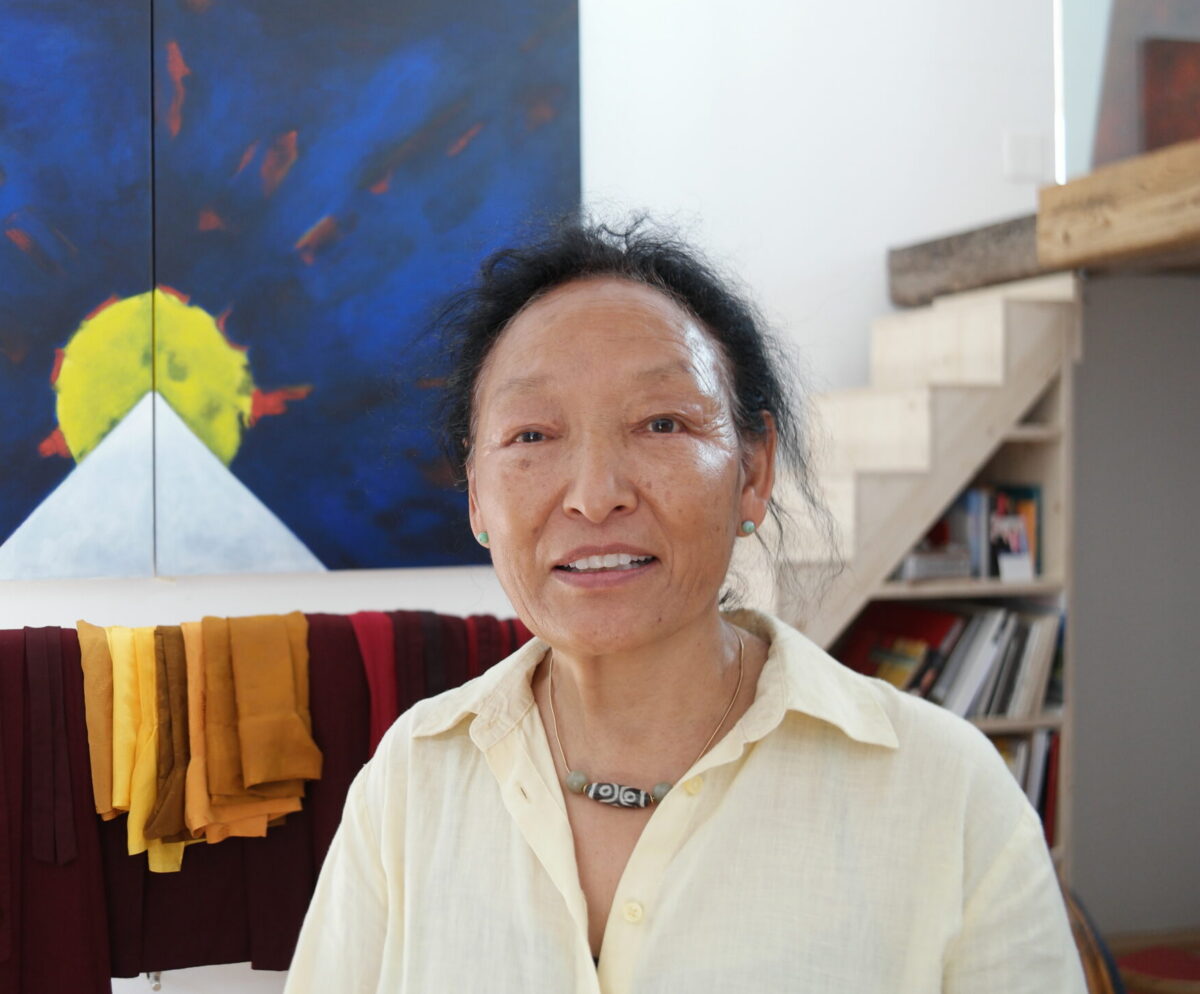
Sonam Dolma
Charleston, SC | Spring 2026
Sonam Dolma (b. 1953) is the only Tibetan-born contemporary female artist of her generation working in the fields of abstract painting and installation. She is especially acclaimed for the elegant simplicity of her large-scale installations that interweave personal memory, Buddhist ritual and spirituality, and the politics of exile. These concerns partly reflect her own experience. Some years after the Chinese takeover of Tibet, when she was six years old, Dolma fled Tibet with her family. She lost her younger sister and her father shortly after the family’s arrival in India. In order to help her mother financially, she herself began laboring in road construction from the age of seven. In the early 1970s, she and her mother emigrated to Switzerland where she has resided since, apart from a four-year sojourn in New York.
Although themes and objects referencing Buddhism and Tibet appear in Dolma’s work, she rejects being labeled as a “Tibetan artist.” She received no training in traditional Tibetan arts, which are guided by strict iconographical and iconometric precepts. Dolma began studying art in 1990, at Art School Bern, and her earliest works—paintings—are decidedly abstract. Many feature vessel-like forms that can be variously interpreted with reference to Buddhist ritual, teachings, and concepts regarding mind and body. In channeling abstraction towards the expression of her particular subjectivities, Dolma extends Tibetan religious and spiritual practices into new and universal visual contexts.
Following Dolma’s move in 2008 to New York City, where she lived for four years, she began working more with installations and these form the core of her practice today. Dolma has fashioned diverse installations addressing a variety of subjects—the situation in Tibet, war, poverty, ecology, for instance. A particularly notable series employs Tibetan votive objects, known as tsa tsas, which the artist creates in multiples using replicas of the heirloom mold with which her family fled Tibet. These installations present powerful images of grief, death, and remembrance; in visual form they make Tibetan religious and spiritual practices universally accessible, demonstrating Dolma’s commitment to exploring contemporary art as a universal language of connection.
During her residency, Dolma engaged with more than one hundred members of the Charleston community to fashion clay tsa tsas for a public performance and installation titled Oneness. She conceived the project in advance of her residency (see link to her statement below). While here, she held various workshops in which participants—while using Dolma’s distinctive tsa tsas molds—created objects enshrining their own personal memories, beliefs, and prayers. Dolma intended Oneness to stand as a call for peace and human interconnectedness, concepts that were manifested in the final performance and installation in which many people participated. While working towards this project, Dolma also produced several paintings that visually connected her Charleston experiences with her own abstracted memory map.
About the Artist
Sonam Dolma received her training at Art School Bern (Switzerland). She works with evocative, often humble materials—used monks’ robes, auspicious scarves, prayer flags, ammunition, hair, and even teeth.
Select Images

Sonam Dolma: Residency, Open Studio, & Interview

Sonam Dolma, FSA Inspired Garden Party + Open Studios, 2026.

Sonam Dolma, "Devotion" (detail), 2026

A tsa-tsa workshop, FSA Spring 2026 Artist Reception.

A tsa-tsa workshop, College of Charleston.

A tsa-tsa workshop, Calvary Episcopal Church.

Sonam Dolma Studio, FSA Inspired Garden Party + Open Studios, 2026.

Sonam Dolma, "Tsa tsas," 2026.

Sonam Dolma, "Oneness," FSA Inspired Garden Party + Open Studios, 2026.

Sonam Dolma, "Erased, Not Gone" (detail), 2026

Sonam Dolma, "Light Blue Echo in Black" (detail), 2026

Sonam Dolma, FSA Inspired Garden Party + Open Studios, 2026.

Sonam Dolma and Guests, FSA Inspired Garden Party + Open Studios, 2026.

Sonam Dolma and Guests, FSA Inspired Garden Party + Open Studios, 2026.

Sonam Dolma, Performance at the Cistern Yard, College of Charleston, 2026.

Sonam Dolma, Performance at the Cistern Yard, College of Charleston, 2026.

Sonam Dolma, Performance at the Simons Center for the Arts, College of Charleston, 2026.

Sonam Dolma, "Oneness" (installation view), Simons Center for the Arts, College of Charleston, 2026.
Read